Bringing Clean Living Indoors: Household Swaps That Actually Matter
You fixed the garden. You swapped the plastic pots for terracotta, ditched the landscape fabric, and started filtering your irrigation water. You did the work of protecting what you grow from an invisible contaminant most people never think about.
Now walk inside.
The indoor environment is where you spend the majority of your hours. It is where you cook, sleep, breathe, and absorb whatever is in the air, the water, and the surfaces you touch. And for most of us, it is also where the highest concentration of avoidable chemical exposures lives: quietly, invisibly, inside products we were told were safe.
This is not about fear. It is about agency. You cannot control what is in the municipal water supply before it reaches your pipes, but you can control what happens after. You cannot reform the chemical industry, but you can decide what lives under your kitchen sink. The home is the one ecosystem where you have real leverage. Use it.
Your home is terrain
The same principle that applies to your garden soil applies to your body: the internal environment either supports health or makes space for dysfunction. Every organ system (liver, kidneys, nervous system, immune response) is quietly processing the load of what comes in. When that load is high, resilience drops. When you lower it, your body has more resources for repair, for maintenance, for the thousand small operations that keep you well.
The things you swap at home are not about purity or perfection. They are about reducing the background noise so your body can do what it already knows how to do.
Kitchen: where the biggest wins live
Cookware. If you do one thing from this entire article, replace your non-stick pans. When non-stick coatings are heated, especially at high temperatures or once they begin to show scratches, they release compounds that have been linked to liver damage, thyroid disruption, and certain cancers. Cast iron, stainless steel, glass, and enameled cast iron last decades and do not off-gas anything into your food. Cast iron in particular is inexpensive, nearly indestructible, and adds a small amount of dietary iron with every use. If you have ever been told cast iron is difficult to maintain, you were lied to. Cook, rinse, dry, wipe with oil. That is the whole routine.
Food storage. Plastic containers, especially when used for hot food or acidic ingredients, leach compounds into whatever they touch. Glass storage containers with snap-lock lids are widely available and inexpensive. But you do not need a matching set. Your stainless steel pots with their own lids make excellent storage containers the moment leftovers cool. I pick these up at yard sales and resale shops for a few dollars. A good stainless pot will outlive you, and a secondhand one costs less than a new plastic container set. For the microwave, skip the plastic wrap entirely. A glass casserole dish lid, an inverted plate, or a simple cloth cover does the job without steaming your food in petrochemicals.
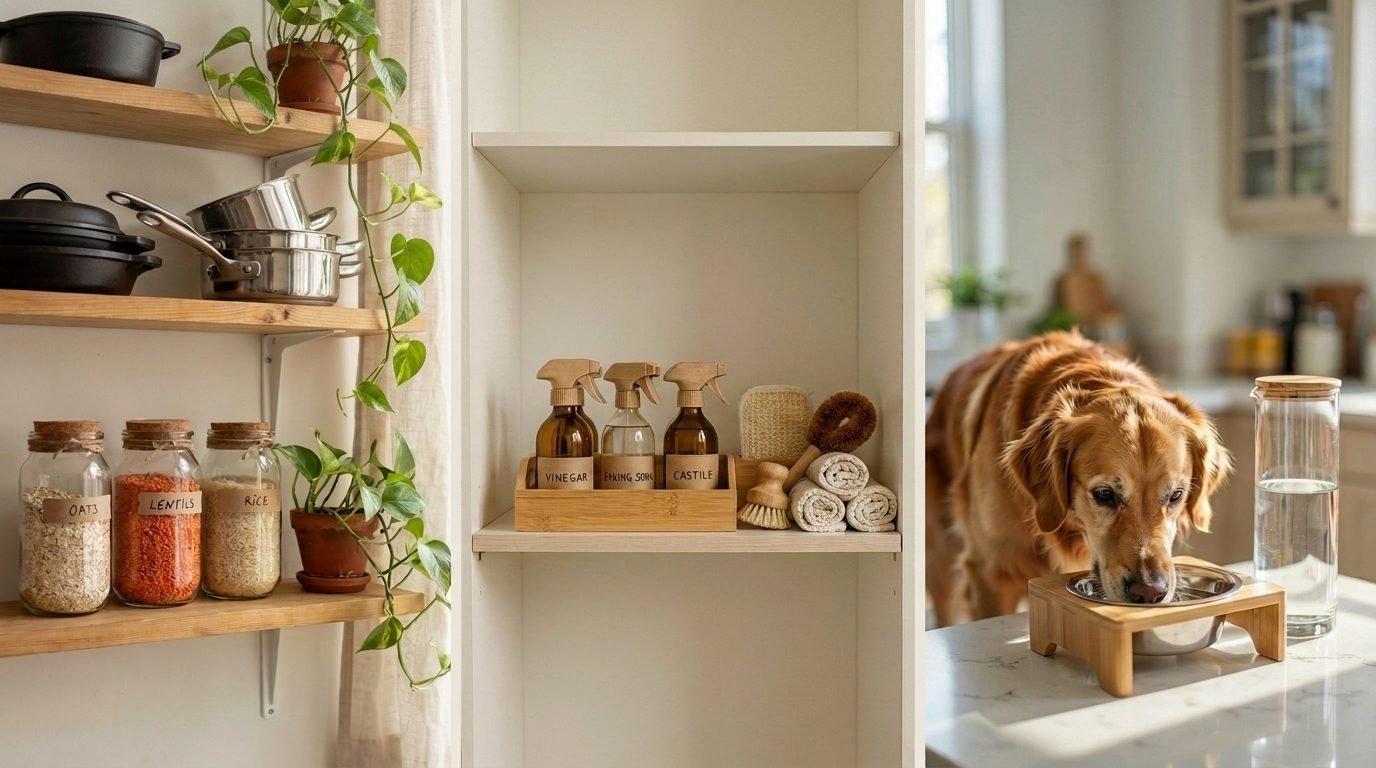
Community water bowls, indoors and out. Those same stainless steel pots, especially the smaller ones, make durable, easy-to-clean water stations for dogs. They do not leach, they do not hold odors, and they survive being knocked over, dragged, and left in the sun. One less plastic bowl in your home. One less thing off-gassing into the water your dog drinks all day.
Water. Municipal tap water carries chlorine, fluoride, disinfection byproducts, and in many areas, measurable microplastics. A carbon filter pitcher is the lowest-barrier entry point and costs less than a month of takeout coffee. A reverse-osmosis system is the gold standard, but start where you are. Even a basic filter reduces the load meaningfully. Your liver and kidneys are already working hard enough.
Cleaning products: what is under the sink
The cleaning aisle is designed to make you feel like you need a different product for every surface. You do not. A small toolkit covers nearly everything:
- White vinegar for cutting grease, removing hard water stains, and general surface cleaning.
- Baking soda for scrubbing without scratching.
- Castile soap for dishes, floors, and anything that needs a gentle surfactant.
- Hydrogen peroxide for disinfecting surfaces.
- Alcohol (70% isopropyl or ethanol) for sanitizing. It evaporates completely, leaves no residue, and kills bacteria and viruses without contributing to antibiotic resistance the way some antibacterial additives do.
- Enzymatic cleaners for breaking down organic messes: pet accidents, food spills, anything biological. They work by digesting the proteins and fats rather than masking them with fragrance.
None of these contain synthetic fragrances, which are among the most common indoor respiratory irritants and endocrine disruptors. Fragrance is a trade-secret term. Companies are not required to disclose what is in it, and a single “fragrance” can contain dozens of individual chemicals. If a product lists “fragrance” or “parfum” on the label, you are inhaling compounds that were never tested for long-term safety in combination with each other. Fragrance-free is a meaningful label. “Unscented” often is not. It can mean masking agents were added to neutralize smell.
Swap one product at a time. When the all-purpose spray runs out, replace it with a vinegar-based alternative. When the laundry detergent is empty, try a fragrance-free version. You do not need to do a purge. The body responds to cumulative reduction, not to performative perfection.
What you clean with matters too
Magic Erasers are plastic. Melamine foam breaks down into microplastic particles as you scrub. Every time you use one, you are grinding plastic into your sink, your tub, and your wastewater. They are effective, and they are also a direct source of the contamination you are trying to reduce.
Replace your sponges and scrubbers with materials that do not shed plastic:
- Swedish dishcloths, made from cellulose and cotton pulp, fully biodegradable, absorbent enough to replace paper towels for most kitchen tasks. They dry fast and do not harbor bacteria the way a damp sponge does.
- Coconut fiber scrubbers, abrasive enough for stuck-on food, compostable when they wear out.
- Stainless steel chainmail scrubbers, the cast iron lover’s best friend. They remove stuck food without stripping seasoning, rinse clean, and last forever. Cost is about ten dollars.
- Wooden dish brushes with natural fiber bristles. The heads are replaceable and compostable.
Steam cleaning is another option that uses nothing but water. A handheld steam cleaner or a steam mop sanitizes surfaces with heat alone: no chemicals, no residue, no fragrance. It works on sealed floors, countertops, grout, bathroom surfaces, and anywhere you would normally reach for a spray bottle. The upfront cost of the device is the only cost, and it replaces multiple cleaning products over time.
Laundry: the room everyone overlooks
Synthetic fabrics (polyester, nylon, acrylic, spandex) shed microplastic fibers every time they are washed. Those fibers exit your washing machine, pass through water treatment that was never designed to filter particles that small, and enter waterways. They also stay in your home as dust, which you then inhale.
A microfiber filter bag (like a Guppyfriend) or an external washing machine filter captures a significant portion of these fibers. Choosing natural fibers (cotton, linen, wool, hemp) when you replace clothing reduces the problem at the source. And switching to fragrance-free detergent eliminates another vector of indoor chemical exposure.
Dryer sheets are another easy cut. They coat fabrics in synthetic fragrances and softening agents that sit against your skin for hours. Wool dryer balls do the same job without the chemical load and last for years.
What goes on your skin
Your skin is not a barrier in the way most people imagine. It absorbs. What you put on it (lotion, deodorant, sunscreen, makeup, soap) enters your bloodstream, bypassing the liver’s first-pass filtration that oral intake gets.
You do not need to replace everything tomorrow. But when something runs out, read the label on the replacement. Fewer ingredients you cannot pronounce. Fragrance-free when possible. Products that list what they contain instead of hiding behind proprietary blends. The cumulative effect of swapping one product at a time, over months and years, is real.
Indoor air and dust
Open the windows. Even ten minutes a day, even in winter. Indoor air is consistently more polluted than outdoor air because everything inside (furniture, flooring, paint, electronics, cleaning residue) off-gasses into a sealed box. Cross-ventilation is free and effective.
Household dust is not just dead skin and dirt. It is a reservoir for microplastics, flame retardants, and chemical residues that settle out of the air. A vacuum with a HEPA filter captures these particles instead of recirculating them. Damp-dusting picks up what dry-dusting scatters. If you have forced-air heating or cooling, change the filter regularly and use the highest MERV rating your system can handle.
Your pets breathe the same air
Everything you just read applies to the animals in your home, often at higher stakes. Dogs and cats have smaller bodies and faster metabolisms. They spend more time on the floor, where dust and chemical residues concentrate. They groom themselves, ingesting whatever has settled on their fur. They drink from the same water. They breathe the same indoor air.
The non-stick pan you swap protects their liver too. The fragrance-free cleaner protects their respiratory system. The filtered water lightens the load on their kidneys. The stainless steel bowl you filled this morning is not quietly leaching into their water. The HEPA vacuum captures particles that would otherwise end up in their lungs. The enzymatic cleaner handles their accidents without leaving behind a chemical residue they will walk through and later lick off their paws.
You cannot protect them from everything. But the same changes that shift your own terrain shift theirs. Clean living is not a solo practice. It is a shared ecosystem, and the animals in it are beneficiaries of every thoughtful choice you make.
Start where you are
You do not need a full-home detox by Friday. That mindset is marketing, not health. Pick one category. The pan. The water filter. The cleaning spray under the sink. Make the swap when the current thing runs out or wears down, and then move to the next one.
These changes compound. A lower chemical load means less work for your liver every single day. Less inflammatory signaling. More metabolic bandwidth for repair and resilience. None of it is dramatic. None of it happens fast. But months and years of small, consistent reductions add up to a body that is less overwhelmed and more capable of staying well.
The terrain responds when you tend to it. Inside the house, same as in the garden.
If you have not yet read the garden-side companion to this article, start here: Protecting Your Garden from Microplastic Contamination: A Guide for Herbalists and Home Growers.
Get the free Non-Toxic Home Swap Checklist
A one-page printable that takes the guesswork out of where to start. No email required. Swap one thing at a time, at your own pace.
This article is education, not medical advice. It is about lowering your household’s chemical load, not treating any condition. Talk to your provider about your own health questions.
Continue to Cultivate Care